The use of AI in companies is growing rapidly. By 2025, over a third of German SMEs and almost two-thirds of large companies will already be using AI-supported systems – and the trend is rising. What is already visible today in terms of AI use is only the beginning.
The use of AI in German companies has the potential to change economic processes at a speed that eclipses many previous technological developments. New opportunities are opening up in almost all areas of business – from more efficient, targeted decisions to completely new business models.
However, compared to other countries, AI usage in Germany is still progressing slowly. The enormous potential that AI offers for the German economy is still far from being exploited. There are various reasons for this, including organizational, legal, ethical, and technical factors. If you want to keep up in the long term, you should address precisely these issues. We can support you on this journey.
While enthusiasm for AI tools is currently huge, their actual integration into important business processes is often still in its early stages.
Many organizations are currently experimenting with applications and AI assistants without first considering the technological and organizational basis that is urgently needed for professional and sustainable use. What feels like great progress to many is likely to stagnate soon if a stable foundation continues to be lacking.
This can manifest itself in many ways – not least through enormous data protection and security problems, which in the worst case can even spell the end for a company. Given all the possibilities offered by AI, too few users are thinking about this point – especially what specifically needs to be considered and implemented here.
There is only one way to avoid this: consciously plan the use of AI and integrate it into the company in such a way that all important aspects are taken into account right from the start.

Find out more about our AI hosting offers – secure, powerful AI infrastructure for businesses.
But before you decide to bury your head in the sand, remind yourself once again:
AI can create significant added value in almost every area:
• Process automation: data collection, invoice processing, document analysis
• Data analysis & forecasting: sales planning, market and risk assessment
• Customer service: chatbots, automatic ticket processing, 24/7 response times
• Marketing & communication: personalization, target group analysis, conversion optimization
• Quality assurance: error detection, production monitoring, predictive maintenance
The resulting increase in efficiency, cost reduction, and greater agility are crucial for business success and competitiveness in the age of AI.
In order to take the above-mentioned levels into account, the use of AI in German companies requires a combination of (technical) AI expertise, particularly high data security and quality, and a powerful, stable, and secure IT infrastructure.
Only on this basis can AI unleash its full potential for your company.
Sustainable innovation through AI requires trust, security, and independence.
The quality of the results that AI ultimately delivers is based on the data it is trained and works with. This means that this database must be as accurate and up-to-date as possible from the start.
This needs to be examined before the topic of AI gains momentum in the company. If you want to avoid chaos, you need structured processes and clear responsibilities.
Data protection already plays an important role at this point: in order to operate AI in compliance with the GDPR, it is important that the relevant data protection criteria are taken into account from the very beginning. This in turn means that all employees who will be working on or with AI must be trained accordingly.
Plan the organizational effort in advance – and don't forget your data protection officer!
In our increasingly networked economy, trust is the key asset. Employees, partners, and customers must be able to trust that their data will be processed and stored securely. Only on this basis should new ideas be freely developed and innovations implemented without risk for all involved.
One particular strength of artificial intelligence lies in its ability to analyze huge amounts of data in a fraction of a second, recognize patterns, and derive precise results and recommendations for action. This requires the technology, especially the servers on which your AI runs, to be able to process very high computing loads. This calls for appropriately powerful hardware. The components must be intelligently coordinated with each other in order to meet the high requirements.
Have you ever thought about this?
To operate powerful AI, you need:
• GPU servers for parallel processing of large amounts of data
• fast NVMe SSDs and RAM for optimal performance in data-intensive processes
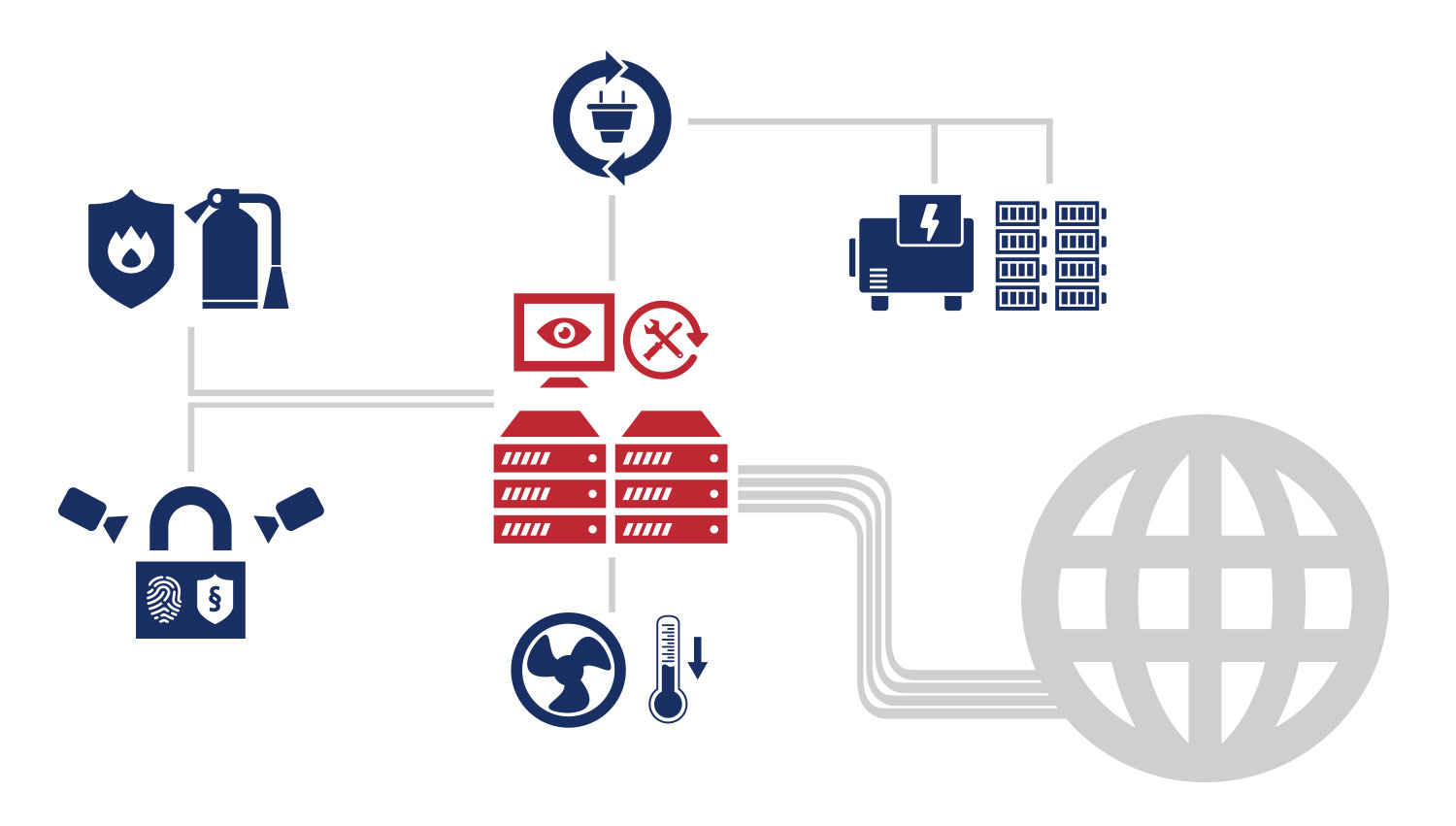
• cooling & redundancy which are essential for continuous operation without risk of failure
At the same time, these servers also consume a lot of energy. Therefore, you should also pay attention to:
• energy efficiency and green electricity for lower operating costs and sustainable, responsible operation of your AI
A powerful infrastructure is the backbone of every AI application.
Sensitive customer and company data, including data on employees and processes, must be strictly protected. This goes far beyond the already mentioned data protection in an organizational sense.
For companies, security involves much more than firewalls or access controls. Security systems that protect systems from cybercriminals, theft, spying, fire, or other environmental influences are essential. If, for example, you have developed AI in your company that significantly supports your unique processes, an attack would jeopardize not only your competitiveness but also your business activities themselves.
For this reason, it is absolutely reckless to develop or operate AI in an inadequately secured environment.
Summarizing the aspects mentioned so far, the following factors emerge:
Data protection and compliance: GDPR compliance, audit-proof processes
System availability: high-performance, fail-safe server infrastructure
Cyber resilience: protection against attacks, ransomware, data leaks, and manipulation
Transparency: traceability of data flows and decisions regarding AI
The long-term performance of any AI depends on the quality of the infrastructure, data, and security. Neglecting these fundamentals risks wrong decisions, security breaches, or legal consequences.

Digital independence means, above all, determining for yourself where and how your data is processed.
Many companies have experienced how quickly dependencies on large US cloud providers can become a risk – whether due to price changes and the resulting increase in costs, licensing models, or even geopolitical tensions. Those who rely on their own or European infrastructure choose digital sovereignty and can shape AI in their company according to their own standards – securely, independently, and sustainably.
Companies should ensure that they have complete control over the storage location, access rights, and operating environment of the AI. Anything else would pose an unpredictable risk to your data, your success, and, in case of doubt, your entire company.
A customized AI solution is therefore more than just an option – it is increasingly becoming a necessity for companies that want to combine data protection, efficiency, and competitive advantages.
Essentially, companies today face two realistic paths:
Developing your own AI solution offers maximum control and flexibility. Companies can:
An AI developed in-house enables:
This approach requires more initial expertise, but offers the greatest independence and the strongest leverage on your own processes.
Not every company has to start AI from scratch. An attractive alternative is to integrate commercial AI models into your own controlled infrastructure – for example, in a private cloud or on dedicated servers.
This enables:
Many modern models and providers now offer “self-hosted” or “on-premises” variants. This allows commercial models such as GPT-like systems, image analysis models, or automation AIs to be operated in your own environment without data being transferred via external cloud services.
This hybrid strategy combines the power of commercial AI with the security of a closed, sovereign infrastructure.
Having your own AI – whether developed entirely in-house or commercially integrated – gives companies true digital sovereignty. Control includes, in particular:
These factors make having your own AI a strategic advantage that not only increases technological efficiency but also strengthens data protection, integrity, and independence.
With our AI hosting solution for businesses, you can use your own AI models, remain independent, and protect your data – including GPU power for optimal performance.
The AI Act – the regulation on artificial intelligence – is the first comprehensive law worldwide, introduced by the European Union to regulate the development, marketing, and use of AI systems.
Its main objective is to ensure that AI in the EU is safe, respects fundamental rights and European values, and promotes innovation. The law follows a risk-based approach:
The higher the risk an AI system poses to the safety or rights of citizens, the stricter the requirements are.
As an EU regulation, the AI Act therefore applies directly in Germany.
Companies must therefore primarily classify their AI systems according to risk and take the appropriate compliance measures. Specifically, this means:
In addition, there will be additional regulations in some areas directly affecting Germany in the coming years. For this reason, it is important that companies pay attention to legal restrictions, health and safety risks, and transparency before and during AI development and use.

Many companies believe that they have already taken a big step forward by using AI. However, the real challenge lies in secure, confident, and sustainable integration.
Only those who retain control over data, systems, and infrastructure can exploit the full potential of artificial intelligence—and thus make innovation truly sustainable.
The path to successful AI in companies requires a stable foundation of security, trust, and independence.
Anyone who wants to operate AI professionally, in compliance with the GDPR, and with high performance needs an environment that meets these requirements.
We offer specialized AI hosting with GPU servers in Germany – so that you and your company can develop and operate your own AI for business success on a stable and secure basis.